


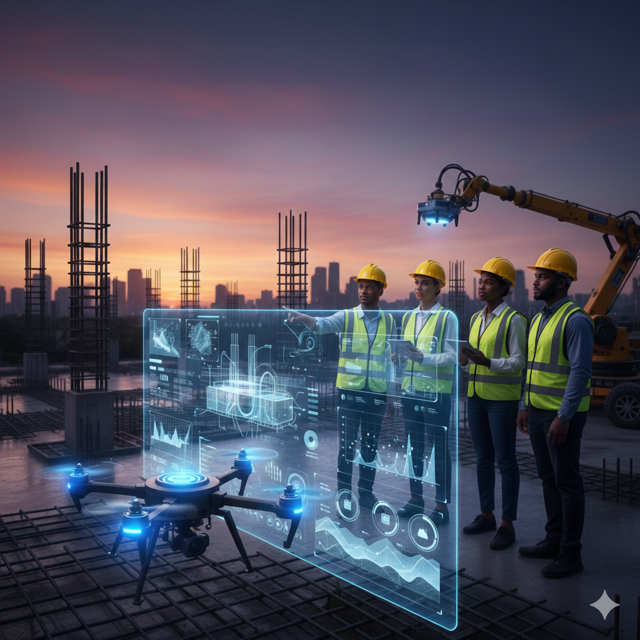


Artificial intelligence is fundamentally changing how geotechnical engineers work. From automated site characterization to real-time monitoring of ground behavior, AI-powered tools are enabling faster, more accurate, and more comprehensive analyses than ever before. But unlike other engineering disciplines where AI primarily assists with pattern recognition or predictive modeling, in geotechnics AI can directly execute the calculations — following established standards and methods — while simultaneously providing the interpretation and cross-verification that traditionally required senior engineering judgment.
The Traditional Workflow and Its Limitations
A typical geotechnical calculation workflow involves: gathering site investigation data (SPT, CPT, lab tests), selecting appropriate analysis methods based on the problem type and applicable codes, entering parameters into specialized software or spreadsheets, running calculations, interpreting results, and producing reports. Each step takes time, requires specialized knowledge, and is prone to errors — particularly in parameter entry and method selection.
Consider a liquefaction assessment: the engineer must correct raw SPT values for hammer energy, borehole diameter, rod length, and sampler type; normalize for overburden; calculate cyclic stress ratios at multiple depths; apply magnitude scaling factors; and compare with empirical resistance curves. Doing this for a single soil layer using one method takes 15–30 minutes. Repeating it for multiple layers using multiple methods (as best practice recommends) multiplies the effort significantly.
Natural Language as Interface
The most transformative aspect of AI-powered geotechnical tools is the natural language interface. Instead of navigating software menus and filling input forms, the engineer simply describes the problem:
"Check liquefaction at 8 meters depth. The soil has SPT N=15, unit weight 19 kN/m³, fines content 12%. The water table is at 2 meters. Design earthquake: magnitude 6.8, peak acceleration 0.3g."
The AI parses this description, identifies the relevant calculation type, maps the values to the correct parameters, selects and executes the appropriate methods, and returns professional-grade results — all in seconds. This is not a simplification of the engineering; it is the same rigorous calculation, just with a radically more efficient interface.
Cross-Method Verification
One of the most powerful applications of AI in engineering is automated cross-verification. For any given problem, multiple valid methods often exist — each based on different assumptions, calibrated on different datasets, and giving slightly different results. In traditional practice, running multiple methods is time-consuming and therefore often skipped.
With AI, cross-verification becomes trivial. For liquefaction, the system runs Seed, Tokimatsu-Yoshimi, and Boulanger-Idriss simultaneously and returns a comparison table. For bearing capacity, it runs Terzaghi, Meyerhof, and Hansen in parallel. If the methods agree, confidence is high. If they diverge, the system flags the discrepancy and helps the engineer understand which assumptions drive the difference.
This capability effectively raises the standard of practice: what was previously done only for critical projects (or not at all) now becomes routine for every calculation.
Design Optimization
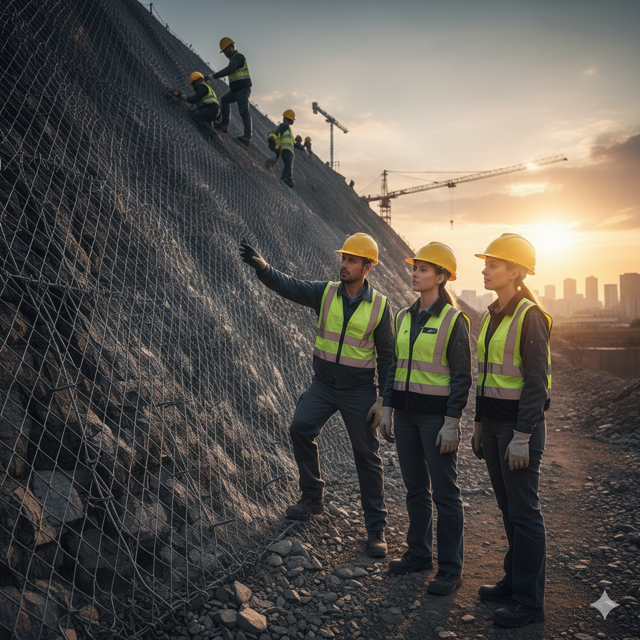
Geotechnical design often involves optimization: finding the most economical configuration that satisfies all safety requirements. For soil nailing, the variables include grid spacing, nail length, bar diameter, drill diameter, inclination, and mesh selection — each with a range of feasible values. The parameter space is enormous: even 5 values per variable creates 5⁶ = 15,625 combinations, each requiring multiple structural verifications.
AI-powered optimization evaluates these combinations exhaustively, applying all required verifications to each candidate, and returns the optimal solution according to the chosen objective (minimize cost, minimize anchor count, maximize safety, or a balanced compromise). It selects from real manufacturer product catalogs and produces results with complete cost breakdowns.
Audit Trails and Professional Accountability
A legitimate concern with AI-assisted engineering is verifiability: can the results be checked? Can they be defended in a design review or legal proceeding? Geostru AI addresses this with a comprehensive audit trail system. Every session generates a unique session ID that enables complete reconstruction of all inputs, computation steps, intermediate values, and outputs. The calculations follow published, peer-reviewed methods with clearly documented parameters — nothing is a "black box."
The engineer remains fully responsible for the design, as they should be. The AI does not replace engineering judgment — it augments it by eliminating manual computation errors, ensuring code compliance, and making cross-verification routine.
Integration with Geotechnical Databases
Beyond calculations, AI can connect directly to geotechnical databases. Geostru AI integrates with the Annali Hydrogeo database, providing access to decades of hydrological measurements from weather stations across Italy — precipitation, temperature, humidity, water levels, flow rates, and precipitation intensity data. This enables engineers to retrieve site-specific hydrological parameters directly within their calculation workflow, without switching between tools or manually looking up data.
What the Future Holds
The current generation of AI geotechnical tools focuses on executing established calculation methods more efficiently. The next generation will likely integrate with real-time sensor data from instrumented slopes, foundations, and excavations — enabling continuous monitoring and early warning of adverse conditions. Predictive models trained on historical performance data could anticipate ground behavior under changing conditions (rainfall, loading, excavation sequences).
Automated report generation — producing formatted calculation reports with all inputs, methods, intermediate values, results, and code references — is another near-term development that will dramatically reduce the documentation burden on engineers.
The engineers who embrace AI tools today are not being replaced by technology. They are amplifying their capabilities, improving their accuracy, and freeing themselves to focus on what matters most: engineering judgment, creative problem-solving, and professional responsibility.
0 Comentarii