


GDW NX
Web-based geotechnical design and verification of gabion retaining walls — both concrete-block gabions and classic double-twisted wire-mesh gabions. Coulomb and Mononobe-Okabe earth thrust, external and internal checks and Bishop global stability, side by side in the browser — no installation, and your projects never leave your device.
What it does
GDW NX takes a gabion retaining wall from geometry and soil profile all the way to a fully verified structure — external, internal and global-stability checks against NTC 2018, with real-time section drawings and traceable reports, entirely in the browser.
Two gabion typologies — dry-stacked concrete-block gabions and traditional double-twisted wire-mesh gabions, each with its own internal-resistance model.
Coulomb and Mononobe-Okabe thrust — active earth pressure in static conditions and the pseudo-static seismic increment per NTC 2018.
External checks — overturning, sliding and the bearing capacity of the foundation soil.
Internal checks, course by course — sliding and section resistance verified at every gabion joint up the wall.
Bishop global stability — the overall stability of the wall and the surrounding soil mass on circular slip surfaces.
Professional deliverables — Word reports, dimensioned section drawings with internal stresses and reusable .gabbioni projects, kept entirely on your own device.
The design methods
Coulomb — active earth thrust (static)
Computes the active thrust the retained soil exerts on the wall from the soil unit weight, shear strength and wall/backfill geometry, including surcharges and the water table.
External safety factors — the factor of safety against overturning and against sliding, each verified when it exceeds the value required by the code.
Bearing capacity — the limit pressure q_lim of the foundation soil checked against the load the wall transmits.
Mononobe-Okabe — seismic thrust
Adds the pseudo-static seismic increment to the static case, using the horizontal and vertical seismic coefficients derived from the NTC 2018 site and importance parameters.
Bishop — global stability
Checks the overall stability of the wall-and-soil system along circular slip surfaces with the simplified Bishop method. GDW NX evaluates one trial circle at a time, so you position and refine the critical surface yourself.
Wall typologies and mesh
The internal resistance of a gabion wall depends on how the baskets are held together. GDW NX models both mesh technologies used in practice.
Concrete-block and wire-mesh gabions — dry-stacked concrete blocks or wire baskets filled with stone, with the fill unit weight you specify.
Double-twisted mesh (DT) — modelled with an internal friction angle of 45° and an apparent cohesion, reflecting the confinement of the double-twisted wire.
Electro-welded mesh (ES) — the internal friction angle is derived from the mesh formula (typically ≈ 26–32°) with no apparent cohesion, giving a more conservative internal check.
Any manufacturer — pick a listed mesh or enter custom specifications from the supplier's data sheet.
How it works
A guided flow takes you from project setup to an exported report in eight steps.
1 · General data & standard — project description and the design standard (NTC 2018, Eurocodes or user-defined), with the partial-factor combinations.
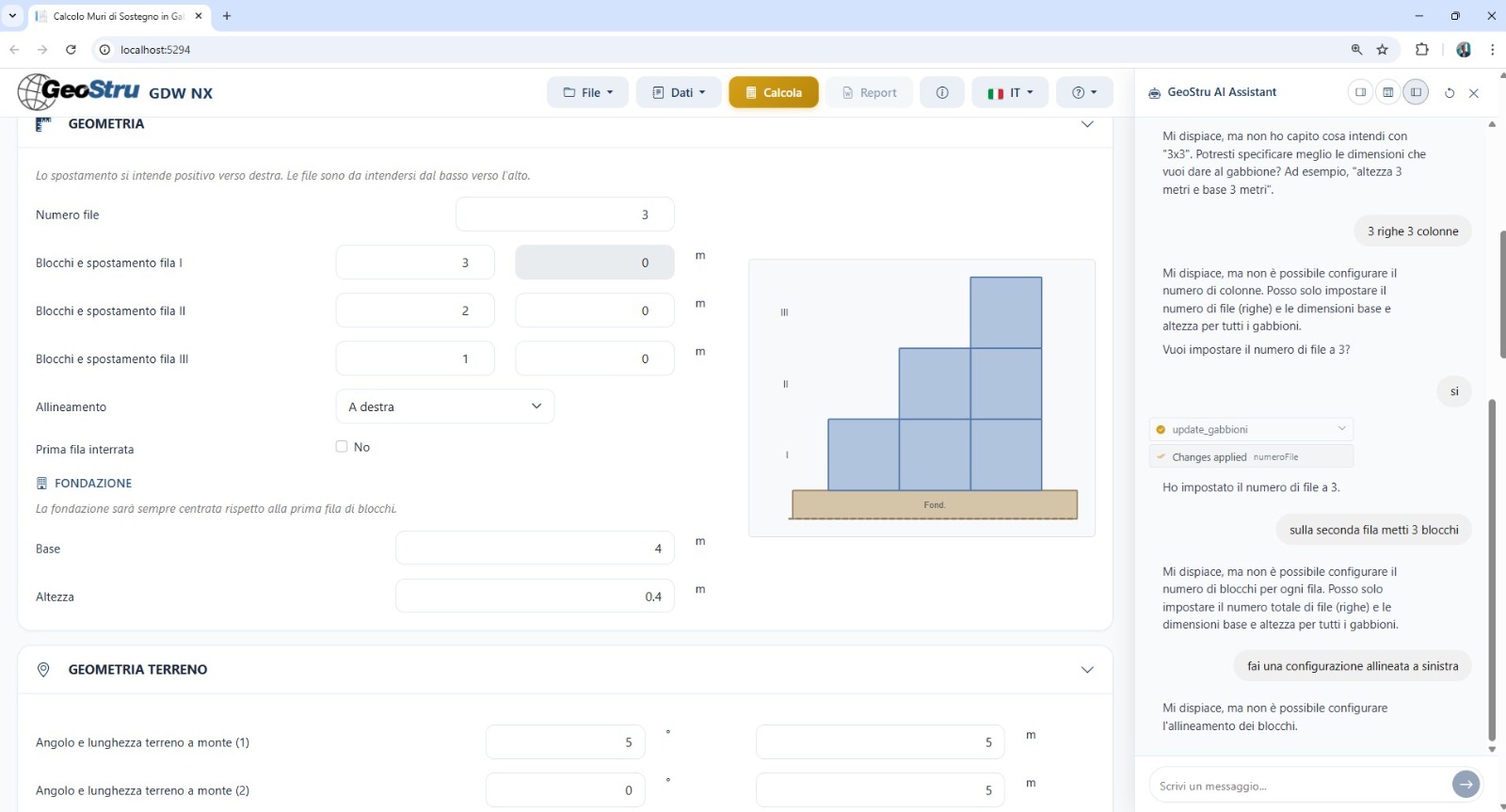
2 · Geometry — number and size of gabion rows, wall inclination α and left/right alignment, drawn in real time.
3 · Foundation — base width, valley (downhill) thickness and inclination β; the foundation is optional and independent of the wall inclination.
4 · Materials — mesh technology (DT or ES), block/fill unit weight and the resulting internal-resistance parameters.
5 · Stratigraphy & water — layered soil profiles with unit weight γ, friction angle φ and cohesion c, plus the groundwater table.
6 · Loads — permanent and variable surcharges (G/Q), tie-rods and nails, and the seismic action.
7 · Checks & results — external, internal course-by-course and Bishop global-stability results, each with its safety factor and pass/fail.
8 · Export — Word report, dimensioned section drawings and the reusable .gabbioni project.
Inputs and outputs
What you enter
Wall geometry — gabion rows and sizes, wall inclination α, alignment, foundation base, thickness and inclination β.
Mesh & fill — mesh technology (DT/ES) or a custom mesh, block/fill unit weight.
Stratigraphy — layered soils with γ, φ, c and the water table.
Loads — permanent and variable surcharges, tie-rods and nails, and the seismic parameters.
What you get
Verifications — safety factors for overturning, sliding, bearing capacity, the internal course-by-course checks and Bishop global stability.
Internal stresses — the forces and resistances at each gabion course.
Drawings — a dimensioned section with the internal stress distribution.
Deliverables — a Word report and a reusable .gabbioni project, stored on your device.
Loads, reinforcement and seismic
Surcharges — permanent (G) and variable (Q) surcharges on the backfill; enter the quasi-permanent value where the combination coefficient Ψ₂ applies.
Tie-rods and nails — add active tie-rods or passive nails to raise the wall's resistance where the checks require it.
Seismic action — the Mononobe-Okabe increment driven by the horizontal and vertical seismic coefficients from the NTC 2018 site parameters.
Who it's for
Geotechnical and structural engineers · Consulting studios · Site technicians. GDW NX is for anyone who designs or verifies gravity gabion retaining walls — for road embankments, river and channel works, landscape engineering and slope stabilisation — and wants a single web environment that goes from geometry and soil to a fully verified structure with traceable NTC 2018 output.
Why it's different
Runs directly in the browser — no installation, no hardware key, always up to date.
Both gabion typologies and both mesh technologies (DT and ES) in one place.
The full NTC 2018 check set — external, internal course-by-course and Bishop global stability — side by side.
Real-time section drawings that show the internal stresses as you design.
Your projects never leave your device — GDW NX stores nothing on its servers.
Traceable Word reports and reusable .gabbioni projects.
Frequently asked questions
What's the difference between double-twisted and electro-welded mesh?
Double-twisted mesh (DT) is modelled with an internal friction angle of 45° and an apparent cohesion; electro-welded mesh (ES) derives its friction angle from the mesh formula (about 26–32°) with no cohesion, so it gives a more conservative internal check.
Does GDW NX find the critical Bishop circle automatically?
No. It evaluates one trial circle at a time, so you position and refine the critical slip surface yourself.
Can I use meshes from other manufacturers?
Yes. Choose a listed mesh or select "Custom" and enter the specifications from the manufacturer's data sheet.
Is the foundation always required?
No. Set its height to zero to omit it; the foundation inclination β and the wall inclination α are independent parameters.
Where are my projects stored?
On your own device. GDW NX does not keep your projects on its servers; a recent project can be restored from the browser for a few days after you close it, and .gabbioni files are backward-compatible.
Is there a desktop version, and does it work on a tablet?
GDW NX is web-only. You can view projects on a tablet, but a PC with a keyboard is recommended for editing.
Ready to start with GDW NX?
Choose your plan and start using GDW NX today. Runs in the browser, always up to date, no installation required.