


HID NX (Hydraulic Invariance Design)
Web-based hydraulic invariance — sizing of stormwater attenuation systems so that a development does not increase the peak discharge to the receiving water. Five methods computed side by side, regulatory profiles for Italy and abroad, and an AI assistant that sets up a project from a plain-language description. Opens in any browser — no installs, no hardware keys.
What it does
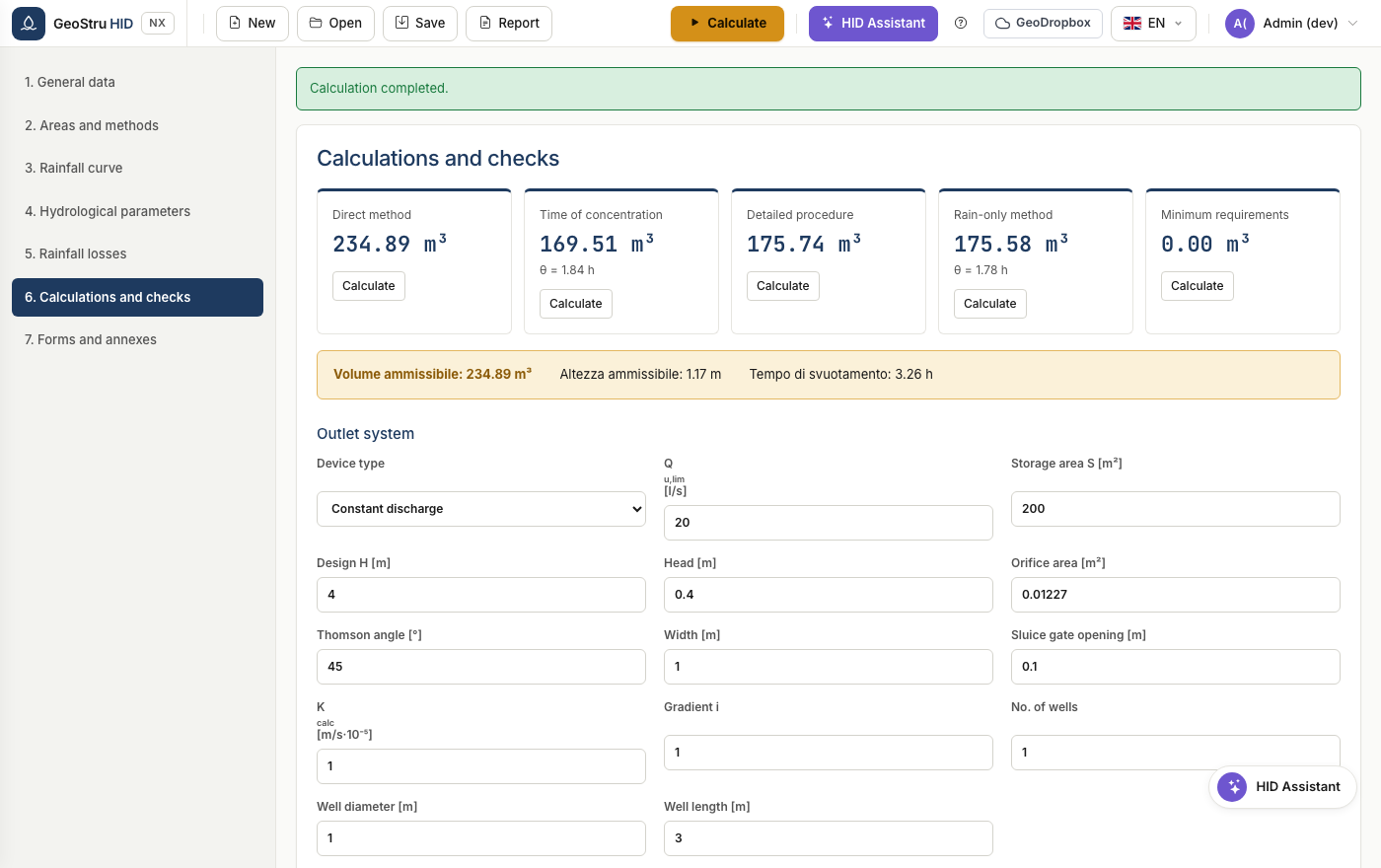
Five sizing methods side by side — minimum requirements, rain-only, direct method, time of concentration and the detailed procedure, computed together with the governing storage volume always in view.
Drainage areas and runoff — each surface with its area and runoff coefficient, with the weighted φ and the impervious-equivalent area recomputed as you type.
Rainfall curves — GEV or two-parameter depth-duration-frequency curves, with a separate sub-hourly exponent and the 28 standard durations tabulated and plotted.
Design storms and losses — Chicago, uniform, Sifalda and triangular hyetographs, with percentage, Horton or SCS-CN rainfall losses computed per surface.
Hydrographs and routing — time-of-concentration and Nash models, routed through the storage step by step against the real outlet law, not a constant discharge assumption.
Eight outlet devices — constant discharge, Thomson, Bazin and Crump weirs, submerged orifice, sluice gate, constant infiltration and infiltration wells.
Regulatory profiles — Lombardia (R.R. 2017, 2019 and 2025), Emilia-Romagna and Marche, plus a generic international profile. The app shows only the fields the selected rules actually require.
AI assistant — set up a whole project from a plain-language description, and get every input and result explained in context.
Reports and cloud save — the calculation report is generated natively in Word (DOCX), DOC and PDF, in seven languages, with cloud project save on GeoDropbox.
How it works
A guided flow takes you from the drainage areas to a fully verified, reported attenuation design.
1 · Areas & methods — enter the drainage surfaces with their runoff coefficients, then pick the sizing methods you want compared.
2 · Rainfall curve — enter the GEV or two-parameter coefficients and the return period, and check the depth-duration curve.
3 · Hydrology & losses — curve number, time of concentration and specific storage per surface, then the design storm and the loss model.
4 · Storage & outlet — set the storage area and design head, choose the outlet device, then run the calculation.
5 · Checks — read the governing storage volume, the required height and the drain-down time against your design values.
6 · Report & save — generate the report in Word (DOCX), DOC or PDF in seven languages, and save the project to GeoDropbox.
Who it's for
Hydraulic engineers · Civil engineers · Geologists · Land-development designers. HID NX is built for those who today must attach a hydraulic invariance report to a building permit, a masterplan or a discharge authorization.
Frequently asked questions
What does HID calculate?Five methods run together, so you read the governing storage volume at a glance: minimum requirements, rain-only, direct method, time of concentration and the detailed procedure — the last one a step-by-step simulation of the design storm, the losses, the hydrograph and the routing through the storage.
Can the AI assistant set up the project for me?Yes. It builds the project from a plain-language description — surfaces, runoff coefficients, rainfall curve and outlet — and explains every input and result in context.
What languages does the report support?Seven — Italian, English, German, French, Romanian, Spanish and Polish. The language you pick in the toolbar applies to the report too, not just the interface.
Which regulations does it cover?Lombardia (R.R. 7/2017 with the 2019 and 2025 updates), Emilia-Romagna and Marche, each with its own required inputs, allowed methods and prescribed discharge limit. Everywhere else a generic international profile lets you set the discharge limit and the minimum volume yourself.
Can I use it outside Italy?Yes. The hydrological engine is universal; only the regulatory layer is country-specific. Pick the generic profile, enter your own rainfall coefficients and the discharge limit set by your local authority, and the app works the same way.
Ready to start with HID NX?
Choose your plan and start using HID NX today. Runs in the browser, always up to date, no installation required.