


Loadcap NX
Web-based bearing-capacity and settlement design for shallow foundations — six classical methods (Terzaghi, Meyerhof, Hansen, Vesic, Brinch-Hansen, Meyerhof-Hanna), EC7/NTC 2018 partial-factor combinations, live 2D/3D preview and an AI assistant that reads your existing reports. Opens in any browser — no installs, no hardware keys.
What it does
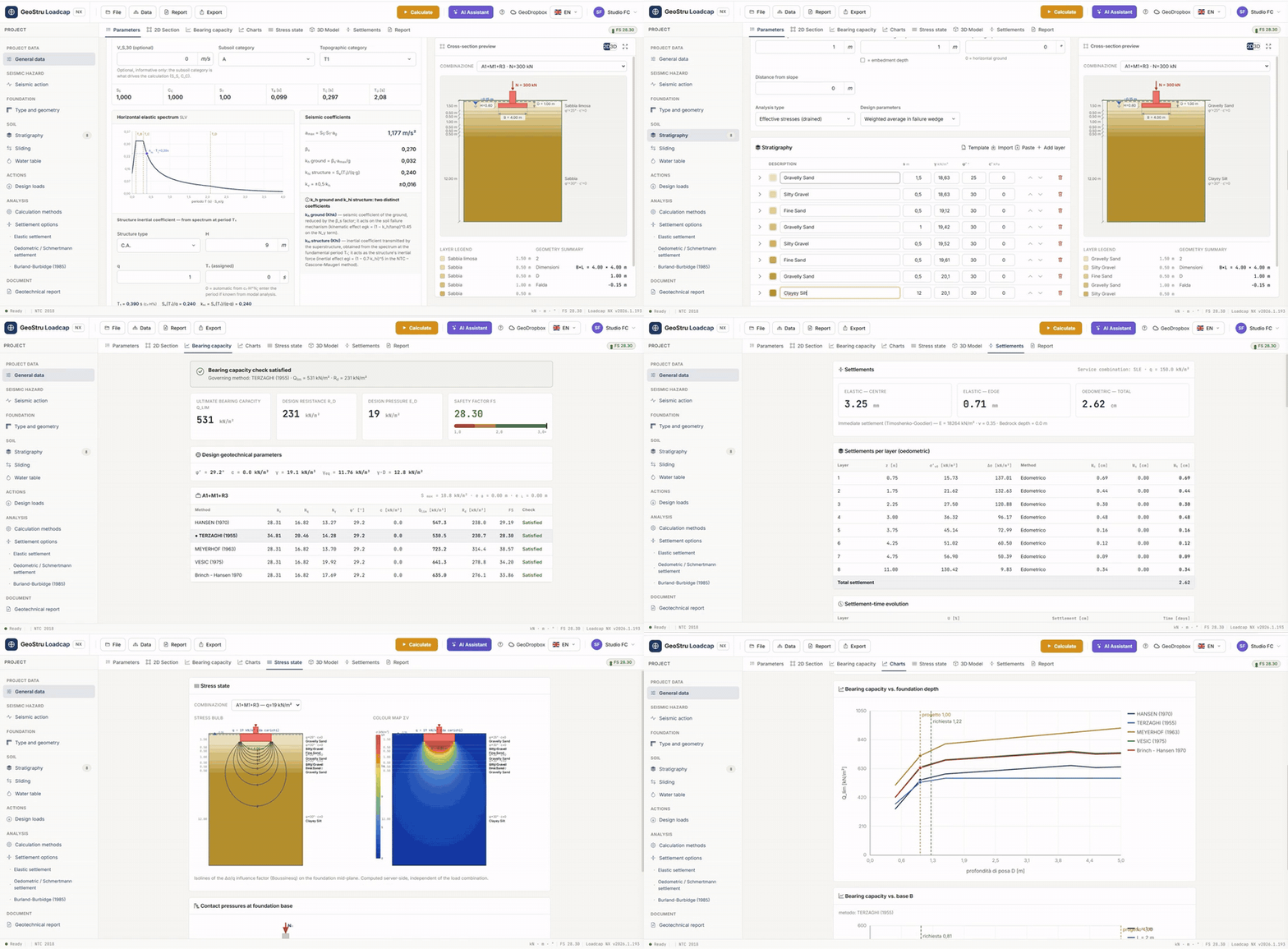
Six bearing-capacity methods — Terzaghi, Meyerhof, Hansen, Vesic, Brinch-Hansen (EC8) and Meyerhof-Hanna for layered soils, computed side by side with the governing Qlim, Qamm and factor of safety.
Four foundation types — strip footing, isolated footing, raft and circular foundations, each with its own geometry and a cross-section that redraws live as you type.
NTC 2018 / EC7 partial-factor combinations — A1+M1+R1, A2+M2+R2, A1+M1+R3, A2+M2+R3, seismic and SLE approaches side by side, R3 as the default, every coefficient editable per combination.
Three settlement methods — elastic (Timoshenko-Goodier), oedometric consolidation and Schmertmann, computed per soil layer, with settlement as a design constraint at SLE.
Sliding verification — the horizontal sliding check against the design resistance, with a consistent sign convention.
Stress state — Boussinesq/Westergaard stress bulb and contact-pressure distribution under the foundation, with isolines and a heatmap.
Live 2D section and 3D model — the foundation block, stratigraphy, water table and load arrows redraw as you edit; a navigable 3D model shows the stress bulb and the differential-settlement surface.
AI-assisted compilation — import an existing geotechnical report (PDF or a structured object) and let the assistant pre-fill the project; the same AI layer explains inputs and results on request.
Localized Word reports — the geotechnical report is generated natively in Italian or English, with cloud project save on GeoDropbox.
How it works
A guided flow takes you from the stratigraphy to a fully verified, reported foundation.
1 · Foundation & site — pick the foundation type and enter the multi-layer stratigraphy, water table and seismic parameters — or import them from an existing report with the AI assistant.
2 · Loads & combinations — enter the design loads for each NTC/EC7 combination, with partial-factor coefficients pre-filled from the chosen approach.
3 · Bearing capacity — compute all six methods side by side and read the governing Qlim, Qamm and factor of safety.
4 · Settlements & stress state — check elastic, oedometric and Schmertmann settlements, and the stress bulb under the foundation.
5 · Sliding — verify the horizontal sliding check against the design resistance.
6 · Report — generate the geotechnical Word report in Italian or English, or save the project to GeoDropbox.
Who it's for
Geotechnical engineers · Structural engineers · Foundation designers · Civil engineering consultants. Loadcap NX is built for those who today verify shallow-foundation bearing capacity and settlements with spreadsheets or desktop tools, and want a single web environment that goes from stratigraphy to a fully verified, reported foundation.
Frequently asked questions
Which bearing-capacity method should I use?
All six run together, so you can compare them on the same soil and loads. Terzaghi and Meyerhof are the classic general-purpose checks; Hansen, Vesic and Brinch-Hansen add shape/depth/inclination factors and seismic terms; Meyerhof-Hanna is for layered soils where a weaker layer lies beneath the founding stratum.
Can I import an existing geotechnical report?
Yes. The AI assistant reads a PDF report or a structured data object and pre-fills the project — stratigraphy, loads and foundation geometry — for you to review before calculating.
What languages does the Word report support?
Italian and English, natively — the same calculation produces a localized geotechnical report in either language.
Is Loadcap NX compliant with NTC 2018?
Yes — partial-factor combinations (A1+M1+R1, A2+M2+R2, A1+M1+R3, A2+M2+R3), seismic and SLE approaches follow NTC 2018 / EC7, with the R3 approach as the default.
What foundation types are supported?
Strip footings, isolated footings, rafts and circular foundations, each with a live 2D section and a navigable 3D model.
Ready to start with Loadcap NX?
Choose your plan and start using Loadcap NX today. Runs in the browser, always up to date, no installation required.