


RockMechanics NX
Web-based limit-equilibrium verification of planar rock-slope stability — Hoek-Bray geometry, Mohr-Coulomb and Barton-Bandis criteria, active anchors, passive nails, drape and cable meshes. Opens in any browser — no installs, no hardware keys.
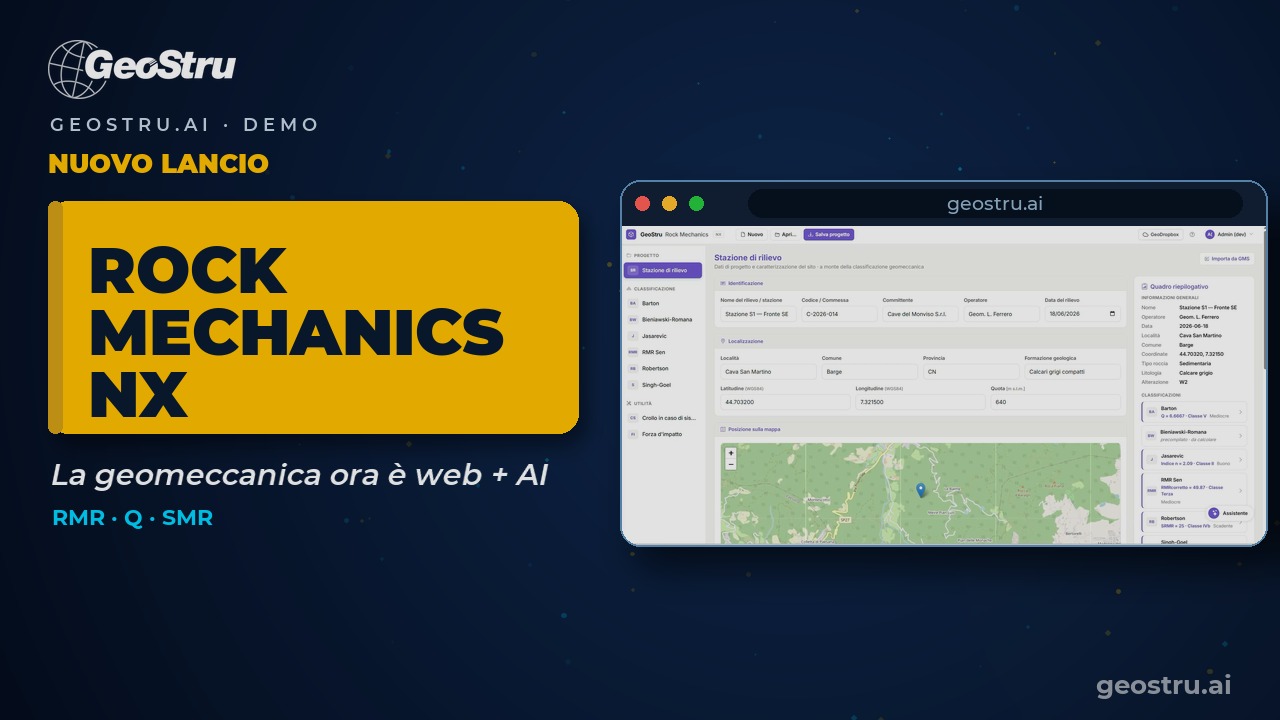
What it does
Six classification systems — Barton Q, Bieniawski RMR with Romana SMR, RMR Sen, Jasarevic, Robertson SRMR and Singh-Goel, side by side.
Derived geotechnical parameters — cohesion, friction angle and deformation modulus computed from each rating, with the method-specific correlations.
Four water states — ponded water at the toe, uplift on the failure plane, thrust in the tension crack, pervious-slope hydraulic connection — with four configurable pressure distributions.
RQD from three methods — core recovery (Lc/Lt), volumetric joint count Jv, or joints per metre, with scoring tables faithful to the originals.
AI assistant — pre-tensioned anchors (NTC §6.6 with ξ and γRa,t), passive nails (NTC §6.7 SoilNail Variant A with Clouterre 1993 N-V interaction), drape mesh R1 and cable panels R2 with full design-resistance breakdown.
Built-in Gemini assistant — when FS falls below target, the auto-designer solves for nail rows, positions and spacing in milliseconds; an optional Gemini-powered AI layer comments the design and proposes motivated refinements.
Cloud projects on GeoDropbox — real-time wedge plot with force vectors and dimensions, plus a navigable 3D model of the block, nails, plates and meshes — four presets (iso, front, side, top).
Word report for every method — eight-section DOCX with a 99-test validation annex, AutoCAD-ready DXF R12 with wedge, nails, water levels and dimensions, and one-click handoff to Trispace NX via secure 5-minute token.
Faithful to the original methods — every scoring table, formula and classification range transcribed verbatim from the established methods.
The classification systems
Every system returns its rating, the rock-mass class and the derived geotechnical parameters — cohesion, friction angle, deformation modulus and GSI — computed side by side so you can compare them.
Barton Q
The Q-index, a product-and-ratio of six joint parameters (RQD, Jn, Jr, Ja, Jw and SRF) on a logarithmic scale from about 0.001 to 1000 — for general characterisation and underground works.
Bieniawski RMR and Romana SMR
The RMR rating summed on a 0–100 scale for tunnels, foundations and slopes, extended by Romana's Slope Mass Rating (SMR) for slope stability.
RMR Sen
A simplified, continuous formulation of the RMR.
Jasarevic
The n-index, calibrated for carbonate rock masses.
Robertson SRMR
A rating tailored to slopes in weak rock.
Singh & Goel
The N-index, for tunnels.
How it works
A guided flow takes you from the geostructural survey to a classified, verified and reinforced slope.
1 · Survey — enter the discontinuity attitudes, spacing, persistence, aperture, roughness, weathering and infilling — or import the survey from GMS or eGeo Compass without re-typing.
2 · Intact rock & RQD — the intact-rock strength (Point Load or Schmidt hammer) and the RQD from core recovery, the volumetric joint count Jv or joints per metre.
3 · Classification — compute the six systems side by side, each with its rating, rock-mass class and derived c, φ and deformation modulus.
4 · Stability — verify planar sliding by limit equilibrium (and the 3D wedge), with the water state, seismic forces and external loads.
5 · Reinforcement — when the factor of safety is short, design anchors, nails and meshes — or let the auto-designer size the nail pattern for you.
6 · Report — export the Word report and the AutoCAD-ready DXF, or hand the project off to Trispace NX.
Inputs and outputs
What you enter
Discontinuity survey — attitude, spacing, persistence, aperture, roughness, weathering, infilling and hydraulic conditions — typed in or imported from GMS / eGeo Compass.
Intact rock and RQD — intact-rock strength (Point Load or Schmidt hammer) and the RQD, from cores or from the joint survey.
Slope and water — the slope and discontinuity geometry, the strength criterion (Mohr-Coulomb or Barton-Bandis), the water state and any seismic or external loads.
What you get
Classifications — the rating and rock-mass class for each of the six systems, with the derived cohesion, friction angle, deformation modulus and GSI.
Stability — the factor of safety for planar and wedge sliding, with the wedge plot and 3D model.
Reinforcement — the anchor, nail and mesh design with its resistance breakdown.
Deliverables — an eight-section Word report per method and an AutoCAD-ready DXF R12, with handoff to Trispace NX.
Who it's for
Geotechnical engineers · Geologists · Slope designers · Mining and quarry engineers · Infrastructure consultants. RockMechanics NX is built for those who today verify rock-slope stability with spreadsheets or desktop tools, and want a single web environment that goes from limit-equilibrium check to fully-designed reinforcement with traceable normative output.
Why it's different
Runs directly in the browser, no installation required.
Covers Barton Q, Bieniawski RMR + Romana SMR, RMR Sen, Jasarevic, Robertson SRMR and Singh-Goel.
Each method computes the rating, the rock-mass class and the derived geotechnical parameters.
Tabbed input for every parameter (RQD, Jn, Jr, Ja, Jw, SRF and more), faithful to the desktop methods.
Frequently asked questions
Which classification should I choose?
For a general characterisation or for underground works, start from Barton's Q-index or Singh & Goel's N-index. For slope stability use Romana's SMR; for soft rock turn to Robertson's SRMR; for carbonate rock masses, Jašarević's n-index is calibrated.
What's the difference between the Q-index and RMR?
Bieniawski's RMR is a sum of ratings on a 0–100 scale; Barton's Q-index is a product-and-ratio of six joint parameters on a logarithmic scale, typically from 0.001 to 1000.
How do I estimate RQD without borehole cores?
From the discontinuity survey — with the Palmström relation RQD = 115 − 3.3·Jv, or the Priest and Hudson formula from the average number of joints per linear metre.
Can I import the survey from GMS or eGeo Compass?
Yes. RockMechanics NX reads geostructural survey data from GMS and eGeo Compass, so you do not have to re-enter the attitudes by hand.
What's the difference between planar and wedge sliding?
Planar sliding is movement along a single discontinuity (2D); wedge sliding concerns a tetrahedral wedge bounded by two intersecting discontinuities, analysed in 3D.
How do I obtain the cohesion, friction angle and modulus of the rock mass?
They are derived automatically from the classifications, using established correlations, to return the cohesion, friction angle and deformation modulus.
Ready to start with RockMechanics NX?
Choose your plan and start using RockMechanics NX today. Runs in the browser, always up to date, no installation required.