


SRS NX
Web-based surface soil-nailing design (chiodatura corticale) for slope stabilization — nail and facing-mesh checks to NTC 2018 / Eurocodes, a commercial nail catalog, a live tabbed workspace and an AI assistant that sets up a project from a plain-language description. Opens in any browser — no installs, no hardware keys.
What it does
Six design checks — bar tension and shear, bar–grout and bulb pull-out, and facing-mesh punching and tension, computed side by side with the governing factor of safety for each.
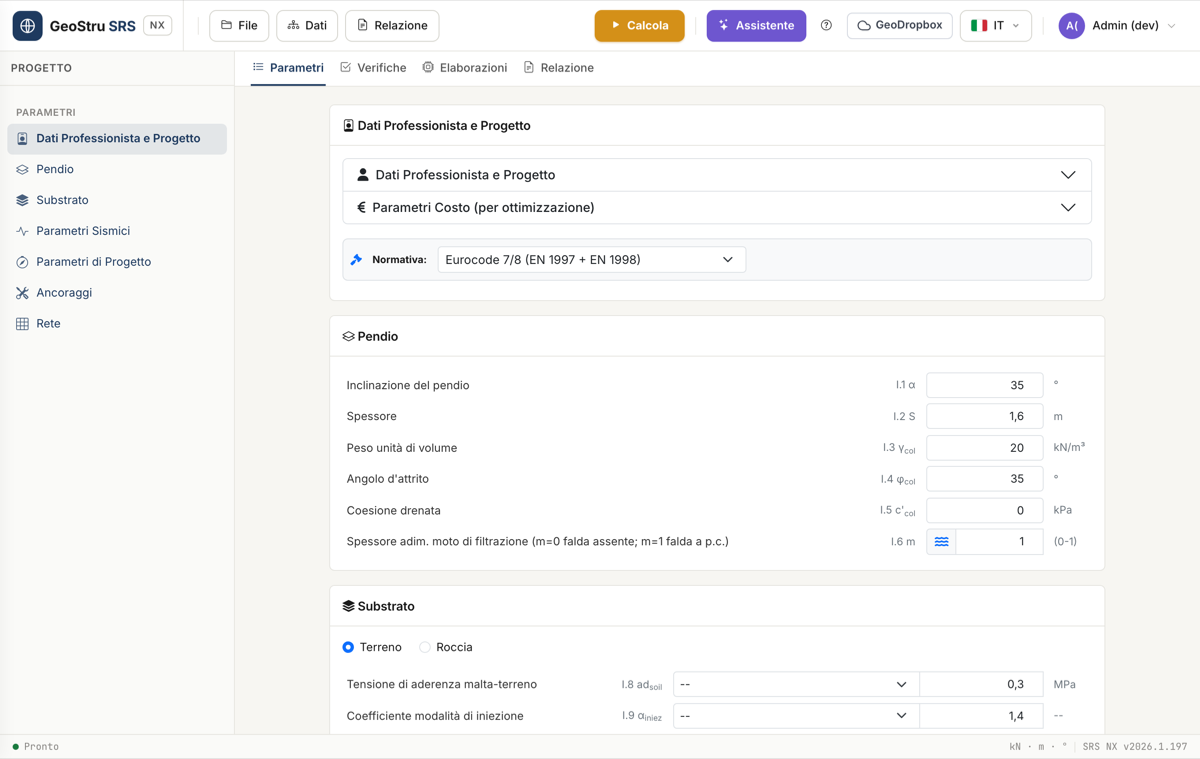
Slope, overburden and substrate — slope inclination and shear strength, overburden thickness and water table, and a soil or rock substrate with its grout bond stress and injection factor.
NTC 2018 / Eurocode partial factors — steel, grout and anchorage resistance factors plus the seismic action, every coefficient editable, raising the slope from the pre-intervention safety factor FS0 to the design one.
Commercial nail catalog — pick a nail or bar (GEWI, TITAN and others) and its diameter, yield strength and resistances fill in automatically, or type your own values.
Facing mesh — double-twist mesh geometry, unit tensile resistance and punching resistance, with the two facing-mesh verifications.
Seismic coefficient from a location — enter the horizontal seismic coefficient, or let the AI assistant fetch it for a town or coordinates from GeoStru Parametri Sismici.
Sidebar, tabs and live results — a project tree in the sidebar, tabbed Parameters / Checks / Elaborations / Report, and the R.2–R.7 verifications each with its own factor of safety.
AI assistant — set up a whole project from a plain-language description, fetch the seismic coefficient for a location, and get every input and result explained on request.
Reports and cloud save — the calculation report is generated natively in Word (DOCX), DOC and PDF, in six languages, with cloud project save on GeoDropbox.
How it works
A guided flow takes you from the slope data to a fully verified, reported soil-nailing design.
1 · Slope & substrate — enter the slope geometry and shear strength, the overburden and water table, and choose a soil or rock substrate — or describe the case to the AI assistant and let it fill the form.
2 · Design target — set the pre-intervention safety factor and the required design factor of safety, the anchor spacing and the reference code.
3 · Nails & mesh — pick the nail or bar from the catalog and the facing mesh, then run the six checks and read the governing factor of safety.
4 · Seismic — enter the horizontal seismic coefficient, or let the AI assistant fetch it for the site from GeoStru Parametri Sismici.
5 · Report — generate the calculation report in Word (DOCX), DOC or PDF, localized in six languages.
6 · Save & share — save the project to GeoDropbox to reopen or share it later, or download the report to your machine.
Who it's for
Geotechnical engineers · Civil and structural engineers · Slope-stabilization designers · Geotechnical consultants. SRS NX is built for those who today design surface soil nailing and facing meshes with spreadsheets or desktop tools, and want a single web environment that goes from the slope data to a fully verified, reported design.
Frequently asked questions
What does SRS check?
The six checks run together, so you read the governing factor of safety at a glance: bar tension and shear, bar–grout and bulb pull-out, and the facing-mesh punching and tension. The slope safety factor is raised from the pre-intervention FS0 to the design one you set.
Can the AI assistant set up the project for me?
Yes. The AI assistant sets up the project from a plain-language description — slope, substrate, nail and mesh — and can fetch the seismic coefficient for a location, for you to review before calculating.
What languages does the Word report support?
Six languages — Italian, English, Spanish, Polish, French and Romanian — the same calculation produces a localized report in the language you choose.
Is SRS NX compliant with NTC 2018?
Yes — partial-factor combinations (A1+M1+R1, A2+M2+R2, A1+M1+R3, A2+M2+R3), seismic and SLE approaches follow NTC 2018 / EC7, with the R3 approach as the default.
What can I reinforce?
Slopes and cuts in soil or rock — road and rail embankments, excavation faces and slopes prone to shallow surface failures — with soil nails and a metallic facing mesh.
Ready to start with SRS NX?
Choose your plan and start using SRS NX today. Runs in the browser, always up to date, no installation required.